
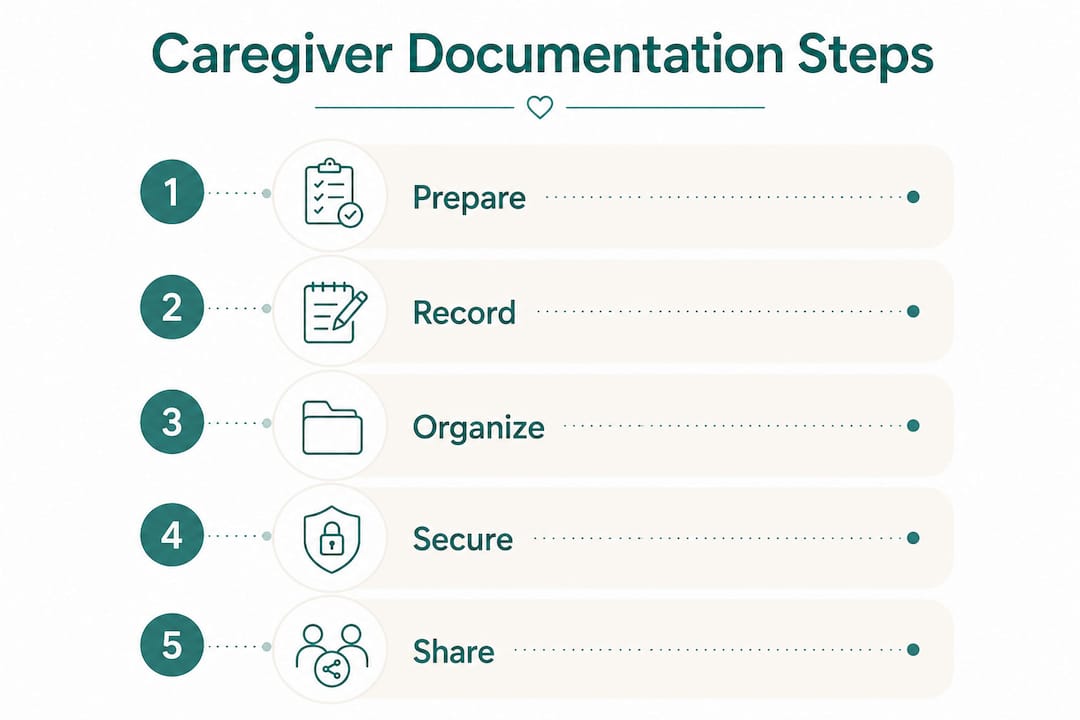
Good caregiver documentation is the difference between a smooth ER handoff and a frantic search through old texts. At its core, it means keeping organized, factual records of every legal authorization, medical detail, and daily observation that affects the person in your care. Family caregivers who build this system early spend far less time scrambling when a crisis hits.
Here is the essential checklist every caregiver should work from:
Legal documents
- Durable power of attorney (financial and healthcare)
- Advance directive or living will
- Healthcare proxy designation
- Guardianship or conservatorship orders, if applicable
Medical documents
- Current medication list with dosages, routes, and schedules
- Diagnosis summaries and treatment histories
- Primary care and specialist contact information
- Health insurance cards and policy numbers
- Immunization records
Daily care records
- Timestamped daily care logs covering meals, mobility, bathing, and behavioral observations
- Medication administration records (MAR)
- Incident and observation reports filed within 24 hours of any fall, injury, or refusal of care
Financial and personal records
- Receipted logs of any financial transactions you manage on the care recipient's behalf
- Emergency contacts with relationship and phone number
- Social Security number, Medicare or Medicaid ID, and insurance policy details
Every entry in a daily log should be factual and timestamped. Objective notes like "refused breakfast at 9:15 a.m." serve as clinical evidence; vague impressions do not.
What legal and medical documents do caregivers actually need?
Legal documents are not created by the caregiver, but you are responsible for knowing they exist, where they are stored, and whether they are current. A durable power of attorney (POA) grants someone legal authority to make financial or healthcare decisions on behalf of the care recipient. There are two types: financial POA covers bank accounts, bills, and property; healthcare POA covers treatment decisions. Both should be signed, notarized, and accessible in your care file.
Advance directives and living wills go a step further. They document the care recipient's own wishes for end-of-life treatment, resuscitation preferences, and organ donation. Without these on file, medical teams default to aggressive intervention regardless of what the person would have wanted.
On the medical side, accurate medication records are among the most critical documents you will maintain. The Institute for Safe Medication Practices identifies missing or informal medication records as a top risk factor for home-based medication errors. A proper medication administration record lists each drug by name, dose, route, scheduled time, actual administration time, and the caregiver's initials.
Emergency contacts deserve more thought than most caregivers give them. The list should include not just family members but the primary care physician, any specialists, the pharmacy, and a backup contact who can make decisions if the primary caregiver is unreachable. Store this list in the care file and post a copy somewhere visible in the home.
Unpaid family caregivers face no federal minimum documentation standard, but paid home care agencies must meet CMS Conditions of Participation, which include explicit clinical record requirements. Many states require home care agencies to retain clinical records for a period defined by regulation, often several years. Even without a legal mandate, informal caregivers who keep thorough records protect themselves and the person they care for.
How to organize and securely manage your caregiving records
A workable system does not need to be complicated. The goal is that anyone stepping in to help, whether a sibling, a substitute aide, or an ER nurse, can find what they need in under two minutes.
Setting up your system
- Create a physical binder with labeled dividers: Legal, Medical, Medications, Daily Logs, Financial, Contacts.
- Mirror that structure digitally using a cloud folder (Google Drive, iCloud, or OneDrive) with the same categories.
- Store original legal documents in a fireproof box or safe; keep photocopies in the binder.
Keeping records current
The CDC recommends updating a care plan at least once a year, or sooner when health status or medications change. Schedule a quarterly review on your calendar. Check that medication lists reflect any recent changes, that provider contact information is current, and that advance directives still reflect the care recipient's wishes.

Privacy and security
Sensitive health information falls under HIPAA protections when handled by covered entities, but family caregivers should apply the same discipline. Do not share records over unsecured email. When using digital tools, choose platforms that offer password protection and encrypted storage. Shred paper documents you no longer need rather than discarding them.
Sharing with healthcare providers and family
When you bring records to a medical appointment, a one-page summary covering diagnoses, current medications, allergies, and recent changes is more useful to a clinician than a full binder. For family members who share caregiving duties, a shared digital folder or a caregiving coordination app keeps everyone working from the same information. Logs are shifting from personal notes to structured evidence in formal programs, and that standard is worth adopting even informally.
Pro Tip: Label every physical folder with the care recipient's name and date of last update. For digital files, use a consistent naming format like "MedicationList_2026-03" so you always know which version is current.
Caregiver support resources worth knowing about in the United States
Two well-established resources stand out for family caregivers navigating documentation and coordination.
| The Senior Alliance | Caring Village | |
|---|---|---|
| Service overview | Area Agency on Aging serving western Wayne County and Downriver Michigan communities; connects caregivers with programs, Medicare counseling, and long-term care planning | Free caregiving coordination app for families managing care from any location |
| Specializations | Support for aging adults and adults with disabilities, MI Choice Waiver Program, caregiver support, Medicare counseling | Care plan organization, family communication tools, task coordination |
| Positioning | Trusted government-linked resource with deep local knowledge of Michigan-area services and eligibility programs | Consumer app built to keep all family caregivers on the same page without cost |
| Pricing | Services are publicly funded through the Area Agency on Aging network; no direct cost to caregivers | Free to use |
The Senior Alliance is particularly useful if you are navigating Medicaid waiver programs or need help understanding what documentation a government-funded program requires. Caring Village works well for families spread across different cities who need a shared space for care plans, notes, and task lists. Neither replaces a formal medical record system, but both reduce the coordination burden that makes caregiving so exhausting.
How digital tools are changing the accuracy of caregiving records
The biggest documentation failure for most family caregivers is not dishonesty. It is delay. Notes written hours after an event lose the specific details that matter: the exact time a symptom appeared, the precise words a care recipient used, whether a medication was taken before or after a meal. Voice-first journaling apps address this directly by letting caregivers record an observation the moment it happens.
Mycarechronicle converts voice notes into a searchable, chronological medical timeline. Instead of a folder of scattered notes, you get a structured record that shows medication history, symptom patterns, and provider interactions in sequence. Multiple caregivers can contribute to the same timeline, which means the night-shift family member and the daytime aide are working from the same record.
Key features that matter for documentation quality:
- Voice-to-text transcription that captures observations in real time, reducing the gap between event and record
- Medication and symptom tracking with timestamps, supporting the kind of structured evidence that reimbursement auditors and medical reviewers expect
- Secure sharing via exportable PDFs or shared links, so a specialist can review the timeline before an appointment
- Multi-caregiver access, keeping the record consistent even when care responsibilities rotate among family members
For caregivers managing someone with dementia, a chronic condition, or a complex medication regimen, this kind of structured log holds real clinical value. A neurologist reviewing six months of timestamped behavioral observations can make a far more informed adjustment than one working from a caregiver's memory of "things got worse around February."
Key Takeaways
Thorough caregiver documentation protects the care recipient, shields the caregiver from liability, and gives every medical provider the context they need to act quickly and accurately.
| Point | Details |
|---|---|
| Legal documents come first | Secure durable power of attorney, advance directives, and healthcare proxy before a crisis forces the issue. |
| Medication records prevent errors | The Institute for Safe Medication Practices flags missing medication records as a top risk factor for home-based errors. |
| Factual, timestamped entries hold up | Every entry in a daily log should be factual and timestamped. Objective notes like "refused breakfast at 9:15 a.m." serve as clinical evidence; vague impressions do not. |
| Review records at least annually | The CDC recommends updating care plans yearly or whenever health status or medications change. |
| Digital tools reduce documentation gaps | Voice-first apps capture observations in real time, producing structured timelines that support medical reviews and family coordination. |