
Caregiver burnout is physical, emotional, and mental exhaustion that builds when the demands of caring for someone else consistently outpace your own recovery. The single most effective first step you can take today: schedule at least a few hours of respite this week and protect a short nightly wind-down routine. Those two actions alone interrupt the cycle before it becomes clinical.
Start here — do these today:
- Block a specific time slot this week when someone else covers care (even two hours counts)
- Set a hard bedtime and a 10-minute pre-sleep routine tonight
- Write down one boundary you will hold tomorrow ("I won't answer care calls after 9 PM")
- Text or call one person who can share a caregiving task this week
These aren't feel-good suggestions. They're the foundation every evidence-based prevention strategy builds on.
Table of Contents
- What is caregiver burnout and how common is it in the U.S.?
- How do you recognize the signs and causes of caregiver burnout?
- A quick self-check to gauge your burnout risk right now
- Evidence-based prevention strategies you can start this week
- How to arrange respite care and build a support network
- How to balance paid work and caregiving without burning out
- When should you seek professional help for caregiver burnout?
- What happens if caregiver burnout goes untreated?
- How Mycarechronicle's Care Chronicle reduces documentation stress
- A 7-day starter plan to reduce your burnout risk
- Key Takeaways
- The part most caregiver guides won't say out loud
- Care Chronicle helps you carry less into every appointment
- Useful sources and next-step resources
What is caregiver burnout and how common is it in the U.S.?
Caregiver burnout, as defined by the Cleveland Clinic, is a state of physical, emotional, and mental exhaustion that results from the sustained demands of caregiving without adequate support or recovery. It's distinct from ordinary tiredness. Burnout involves a shift in attitude, from feeling engaged and purposeful to feeling detached, resentful, or hopeless, and it can impair your ability to provide the care your loved one needs.
About 1 in 3 adults in the United States currently serves as an informal or family caregiver.
That number matters because it means burnout isn't a personal failure or a rare edge case. It's a predictable outcome when millions of people absorb enormous responsibility without systems for relief.
The stakes go beyond the caregiver's own health. When burnout progresses, care quality declines, medical errors increase, and the caregiver's own chronic disease risk rises. Prevention isn't a luxury. It's what keeps the whole arrangement sustainable.
| Dimension | What burnout affects |
|---|---|
| Physical health | Fatigue, weakened immunity, sleep disruption |
| Emotional health | Anxiety, depression, irritability, hopelessness |
| Relationships | Withdrawal from friends, family tension |
| Care quality | Missed medications, reduced attention, higher error risk |
| Work performance | Absenteeism, reduced concentration, job loss risk |
How do you recognize the signs and causes of caregiver burnout?
Burnout rarely arrives all at once. It accumulates through weeks of small depletions, and the signs often look like ordinary stress until they don't.
Emotional warning signs:
- Persistent irritability or anger directed at the person you care for
- Feeling hopeless or trapped with no way out
- Loss of satisfaction or meaning in caregiving
- Anxiety that doesn't ease even when things are calm
- Guilt about your own feelings
Physical warning signs:
- Chronic fatigue that sleep doesn't fix
- Frequent headaches, stomach problems, or getting sick more often
- Changes in appetite (eating too much or too little)
- Sleep disruption even when you have the time to rest
Behavioral warning signs:
- Withdrawing from friends, family, or activities you used to enjoy
- Missing your own medical appointments
- Increased use of alcohol, caffeine, or sleep aids
- Neglecting tasks you'd normally handle without thinking
Common risk factors that raise your odds:
- Providing care for more than 40 hours per week
- Living with the person you care for (cohabitation significantly reduces recovery time)
- Managing complex medical tasks: injections, wound care, feeding tubes
- Financial strain tied to caregiving costs
- Feeling you had no choice in taking on the role
- Lack of social support or a second caregiver to share the load
Self-assessment prompts to use weekly:
Ask yourself: Am I sleeping less than six hours most nights? Have I canceled plans with friends three or more times this month? Do I feel more resentful than caring? Have I skipped my own doctor's appointment? A pattern of "yes" answers across multiple weeks is a signal worth acting on.

Pro Tip: Set a weekly five-minute check-in with yourself, same day and time each week. Treat it like a standing meeting. Spotting a pattern early gives you options; catching it late leaves you fewer.
A quick self-check to gauge your burnout risk right now
Use this as a triage tool, not a diagnosis. The goal is to identify where you are on the spectrum so you know what to do next.
Answer yes or no to each of these:
- Have you felt emotionally exhausted most days for the past two weeks?
- Do you feel like caregiving has taken over your identity entirely?
- Have you had trouble sleeping even when you had the time?
- Have you felt resentful toward the person you care for?
- Have you withdrawn from people or activities you used to enjoy?
- Have you neglected your own health needs (skipped meals, missed appointments)?
- Do you feel like nothing you do makes a difference?
- Have you had thoughts of harming yourself or others?
Scoring:
- 0–2 yes answers: Low risk. Maintain your current habits and add one protective routine this week.
- 3–5 yes answers: Moderate risk. Act now. Schedule respite, contact one support resource, and talk to someone you trust this week.
- 6–7 yes answers: High risk. Contact your primary care provider this week and reach out to a caregiver support group or social worker.
- Question 8 answered yes: Seek help today. Call or text 988 (Suicide and Crisis Lifeline) or go to your nearest emergency room.
Clinicians note that if symptoms persist most days for several weeks or your functioning declines at home or work, that's a red flag for clinical evaluation — not something to push through alone.
Pro Tip: Screenshot or print this self-check and revisit it every two weeks. Tracking your answers over time shows trends that a single snapshot misses.
Evidence-based prevention strategies you can start this week
The National Institute on Aging recommends 7–9 hours of sleep nightly and a short daily relaxation practice, such as a 10-minute nighttime routine, as foundational tools for managing caregiver stress. Those two habits alone reduce cortisol load and improve emotional regulation. Build from there.
Morning (10–15 minutes)
- Eat something before you start care tasks, even if it's small
- Take five slow breaths before entering the caregiving role for the day
- Review your task list and identify one item you can delegate or defer
Daytime micro-actions
- Two 5-minute movement breaks: a short walk, stretching, or stepping outside
- Drink water consistently (dehydration amplifies fatigue and irritability)
- Use a task-batching approach: group errands, calls, and appointments into blocks rather than scattering them across the day
Evening routine
- Stop care-related tasks at a set time when possible
- Spend 10 minutes on something that belongs only to you: reading, music, a short walk
- Write down three things that went okay today (not perfectly, just okay)
- Aim for a consistent bedtime
Mayo Clinic specifically recommends small-step goal-setting over perfectionism as a core strategy for reducing chronic caregiver stress. You don't need a complete wellness overhaul. You need one habit that sticks, then another.
Physical self-care also means addressing the body's wear. Caregivers who lift, transfer, or support someone physically are at real risk for musculoskeletal strain. Paying attention to age-related stiffness prevention through daily movement and stretching can reduce the physical toll that compounds emotional fatigue.
Pro Tip: Schedule your breaks like workplace shifts. Put them on the calendar with a start and end time. When someone asks for that slot, say "I have a commitment." You do.
How to arrange respite care and build a support network
Respite care — temporary relief from caregiving duties — improves caregiver mental health even when it amounts to just a few hours per week. The CDC recognizes it as one of the most effective tools for preventing burnout. The challenge isn't knowing it helps; it's knowing how to arrange it.
Types of respite available in the U.S.:
- Family and friends: The most accessible option. Assign specific tasks rather than asking for vague "help." A master task list with items categorized by complexity (medication administration vs. grocery pickup) makes it far easier for helpers to say yes.
- Adult day programs: Structured daytime programs that provide social engagement, meals, and supervision. Many operate on a sliding-fee scale. Search your county's Area Agency on Aging for local options.
- In-home aides: Professional caregivers who come to the home for set hours. Costs vary widely by region; Medicaid and some long-term care insurance policies cover a portion.
- Short-term facility stays: Temporary placement in a skilled nursing or assisted living facility, sometimes called "respite admission." Medicare covers limited stays following a qualifying hospital admission.
Onboarding a new helper (checklist):
- Write a task list with clear instructions for each item
- Provide a current medication list with dosages and timing
- Share emergency contacts and the person's primary care provider's number
- Note behavioral patterns, triggers, and preferences
- Do one overlap session where you're both present before handing off
Where to find local resources:
- Eldercare Locator (eldercare.acl.gov): connects you to your local Area Agency on Aging
- ARCH National Respite Network (archrespite.org): locates respite programs by state
- AARP Caregiver Resource Center (aarp.org/caregiving): guides, legal tools, and local referrals
Even a few hours of respite weekly carries measurable benefits for caregiver mental health, according to the CDC. You don't need a week off to feel the difference.
Support groups do more than offer emotional validation. Harvard Health notes they function as practical problem-solving forums where members exchange resource leads, caregiving strategies, and onboarding tips. AARP and the Alzheimer's Association both run free in-person and virtual groups across the U.S.

How to balance paid work and caregiving without burning out
Most employed caregivers don't tell their employers what they're managing until a crisis forces the conversation. Getting ahead of it gives you more options.
Scripts for talking to your employer:
- "I'm managing a family health situation and need to discuss flexible start times for the next few months. I've mapped out how my work output stays consistent."
- "I may need occasional short-notice time off for medical appointments. Can we agree on a protocol so I'm not scrambling each time?"
Practical planning tactics:
- Use a shared digital calendar (Google Calendar, Apple Calendar) that all family caregivers can access and update
- Bundle medical appointments on the same day to reduce the number of days you need to leave work early
- Create a delegated task list for family members with specific names next to each item, not "someone should handle this"
- Negotiate one work-from-home day per week if your role allows it; even one day reduces commute fatigue significantly
A brief note on FMLA:
The Family and Medical Leave Act (FMLA) allows eligible employees at covered employers to take up to 12 weeks of unpaid, job-protected leave per year to care for a spouse, child, or parent with a serious health condition. Eligibility requires 12 months of employment and 1,250 hours worked in the past year at a company with 50 or more employees. Talk to HR before you need it, not during a crisis. This is general information; confirm your specific situation with HR or an employment attorney.
When to reassess:
If you're consistently missing work deadlines, your care recipient's needs have escalated beyond what part-time coverage can handle, or you're running on fewer than five hours of sleep most nights, the current balance isn't working. That's a signal to explore expanded respite, a leave of absence, or a care transition, not to push harder.
When should you seek professional help for caregiver burnout?
Some burnout symptoms resolve with rest and support. Others don't, and waiting too long to get clinical help makes recovery harder.
Red flags that warrant contacting a provider this week:
- Persistent sadness, hopelessness, or crying most days for two or more weeks
- Thoughts of harming yourself or the person you care for
- Severe sleep disruption lasting more than two weeks
- Inability to perform basic daily functions at home or work
- Significant weight loss or gain over a short period
- Increasing use of alcohol or substances to cope
If symptoms continue most days for several weeks or your functioning declines at home or work, contact a primary care provider or mental health professional. The Cleveland Clinic identifies persistent functional decline as the clearest clinical threshold for seeking evaluation.
Types of support that help:
- Primary care provider: First stop for ruling out physical causes (thyroid issues, anemia) and getting referrals
- Therapist or psychologist: Cognitive behavioral therapy (CBT) is particularly effective for caregiver-related anxiety and depression
- Social worker: Can connect you to community resources, financial assistance, and care coordination support
- Caregiver counseling programs: Many hospitals and Area Agencies on Aging offer free or low-cost counseling specifically for caregivers
- Psychiatrist: If medication is appropriate for depression or anxiety, a psychiatrist manages that alongside therapy
How to prepare for your first appointment:
Bring a brief symptom log (when symptoms started, how often they occur, what makes them worse), your current medication list, and a short description of your caregiving situation. Providers can help you faster when they understand the context.
What happens if caregiver burnout goes untreated?
Untreated burnout doesn't plateau. It compounds. Chronic stress suppresses immune function, raises cardiovascular risk, and accelerates the progression of anxiety and depression into more severe conditions. Caregivers who don't address burnout are also more likely to make medication errors, miss their own health screenings, and eventually step back from caregiving entirely, often under crisis conditions.
Recovery is realistic, but it takes time. With consistent self-care, respite, and professional support where needed, most caregivers notice meaningful improvement in mood and energy within a few weeks. Full recovery from clinical burnout, where depression or anxiety has taken hold, typically takes several months and benefits from professional guidance.
Factors that speed recovery include early intervention, a reliable support network, reduced caregiving hours, and treatment for any underlying mental health condition. Factors that slow it include continued isolation, financial stress, and caregiving for someone whose condition is deteriorating rapidly.
Nutrition, exercise, and social connection are repeatedly cited by major health authorities as foundational to preventing burnout from progressing to clinical levels. These aren't add-ons. They're the baseline your body needs to sustain the work.
How Mycarechronicle's Care Chronicle reduces documentation stress
One underappreciated driver of caregiver burnout is cognitive overload: the mental weight of tracking medications, symptoms, appointments, and provider instructions across weeks and months. When that information lives in scattered notes, text threads, and memory, every doctor's visit becomes a stressful reconstruction exercise.
Care Chronicle, Mycarechronicle's AI-powered caregiver journal, addresses this directly.
What it does:
- Converts voice notes into a searchable, chronological medical timeline
- Tracks medications, dosages, and symptom patterns over time
- Generates exportable reports and shareable links for family members or clinicians
- Supports multiple caregivers contributing to the same record
Where it fits in a burnout-prevention routine:
- Before doctor visits: Speak a two-minute voice note summarizing the past week's symptoms and medication changes. Care Chronicle organizes it into a timeline you can share or print.
- During family handoffs: Share the current timeline via a secure link so a sibling or backup caregiver has everything they need without a 45-minute phone briefing.
- For medication tracking: Log changes in real time by voice, reducing the risk of errors and the mental load of remembering every adjustment.
Care Chronicle is a documentation and coordination tool, not a substitute for clinical care. It doesn't replace your provider, therapist, or support group. What it does is reduce the cognitive friction that makes caregiving harder than it needs to be, freeing mental bandwidth for the things that actually require your judgment.
A 7-day starter plan to reduce your burnout risk
This plan is designed for caregivers at any stage. Each day has one clear objective. Don't try to do everything at once.
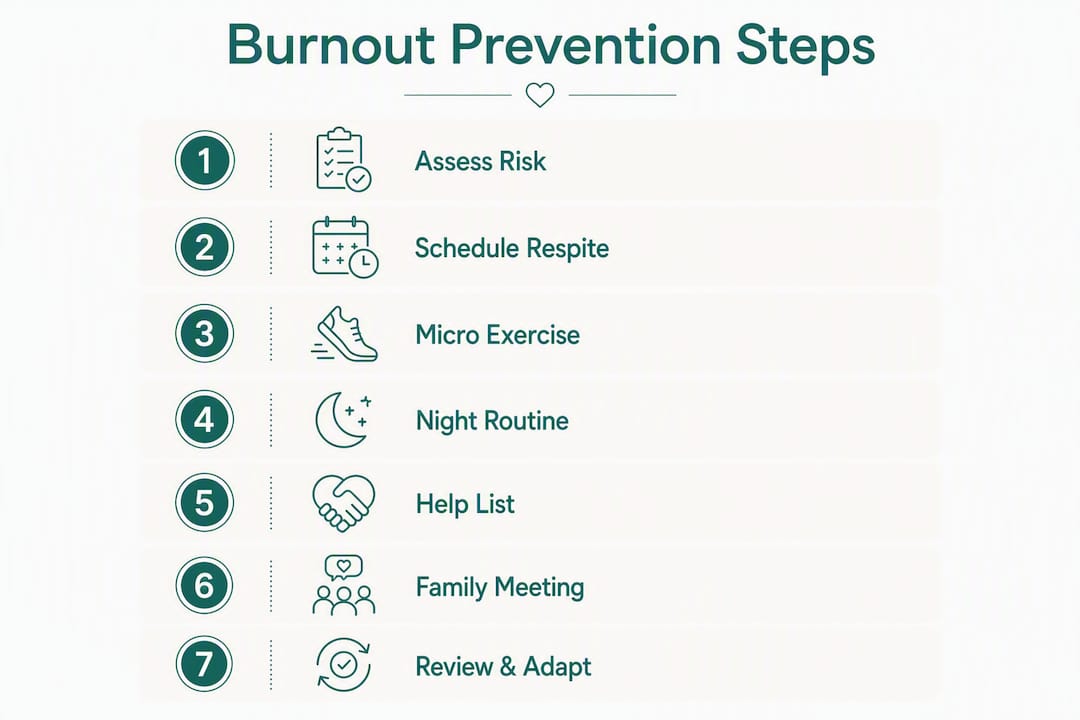
Day 1: Assess. Complete the self-check from Section 4. Write down your score and note which symptoms feel most urgent. This is your baseline.
Day 2: Schedule respite. Identify one person who can cover care for two or more hours this week. Contact them today and confirm a specific time. Put it on the calendar.
Day 3: Add micro-exercise. Take two 5-minute movement breaks today. A short walk, stretching, or climbing stairs counts. Set phone reminders if needed.
Day 4: Build a night routine. Tonight, stop care tasks 30 minutes before bed. Spend 10 minutes on something that's yours alone. Note your sleep hours in the morning.
Day 5: Create a help list. Write a master task list of everything involved in your caregiving role. Categorize by complexity. Identify three items someone else could handle.
Day 6: Brief family meeting. Share the task list with at least one family member or friend. Assign one specific item with a name and a date. Keep the meeting under 20 minutes.
Day 7: Review and adapt. Look back at the week. What worked? What didn't? Adjust one thing for next week. Redo the self-check and compare to Day 1.
Measurement prompts: Track sleep hours each morning (aim for 7–9), rate your mood on a 1–10 scale each evening, and note whether your scheduled respite actually happened.
Adaptations:
- Part-time caregivers: Compress Days 1–3 into the first day if your caregiving hours are limited; the habits still apply.
- Full-time live-in caregivers: Prioritize Day 2 above all others. Respite is non-negotiable when you have no natural breaks.
- Caregivers balancing work: Use Day 6 to also address one workplace accommodation (flexible hours, a remote day) alongside the family conversation.
Small-step goal-setting rather than perfectionism is what Mayo Clinic identifies as the core psychological strategy for reducing chronic caregiver stress. Seven days won't fix everything. They'll show you what's possible.
Key Takeaways
Consistent, small protective habits — scheduled respite, protected sleep, and early help-seeking — are the most reliable way to prevent caregiver burnout from becoming a clinical crisis.
| Point | Details |
|---|---|
| Respite works fast | Even a few hours of relief weekly produces measurable mental health benefits, per the CDC. |
| Sleep is non-negotiable | Aim for 7–9 hours nightly; a 10-minute wind-down routine improves sleep quality. |
| Self-check regularly | Use the 8-question self-check every two weeks to catch burnout patterns before they escalate. |
| Get help at red flags | Persistent symptoms most days for several weeks, or declining function, warrant a provider visit. |
| Mycarechronicle reduces cognitive load | Care Chronicle's voice-to-timeline tool cuts documentation stress and simplifies handoffs to family and clinicians. |
The part most caregiver guides won't say out loud
The conventional framing around caregiver self-care tends to land on "you can't pour from an empty cup," which is true but also a little too tidy. The harder truth is that most caregivers already know they're depleted. The problem isn't awareness. It's that self-care feels structurally impossible when you're the only person holding everything together.
What actually moves the needle isn't a wellness mindset. It's logistics. Respite doesn't happen because you decide to value yourself more. It happens because you put a specific name, date, and time on a calendar and someone shows up. The 7-day plan in this guide is built around that reality. Day 2 isn't "consider respite." It's "contact one person today and confirm a time."
The other thing worth naming: guilt is the most common reason caregivers delay getting help, and it's the least useful emotion in this situation. Reframing self-care as a clinical requirement, not a reward, is what the Cleveland Clinic and Mayo Clinic both point to as the actual behavior-change lever. You're not taking a break because you've earned it. You're taking a break because the person you care for needs you functional next month, not just today.
If you're in the moderate-to-high risk band on the self-check, the most important thing you can do this week isn't read more articles. It's make one call, to a friend, a support group, or your doctor, and say what's actually going on.
Care Chronicle helps you carry less into every appointment
When you're already stretched thin, the last thing you need is to spend 20 minutes before a doctor's visit trying to reconstruct three weeks of symptom changes from memory and scattered texts. That's exactly the gap Care Chronicle was built for.
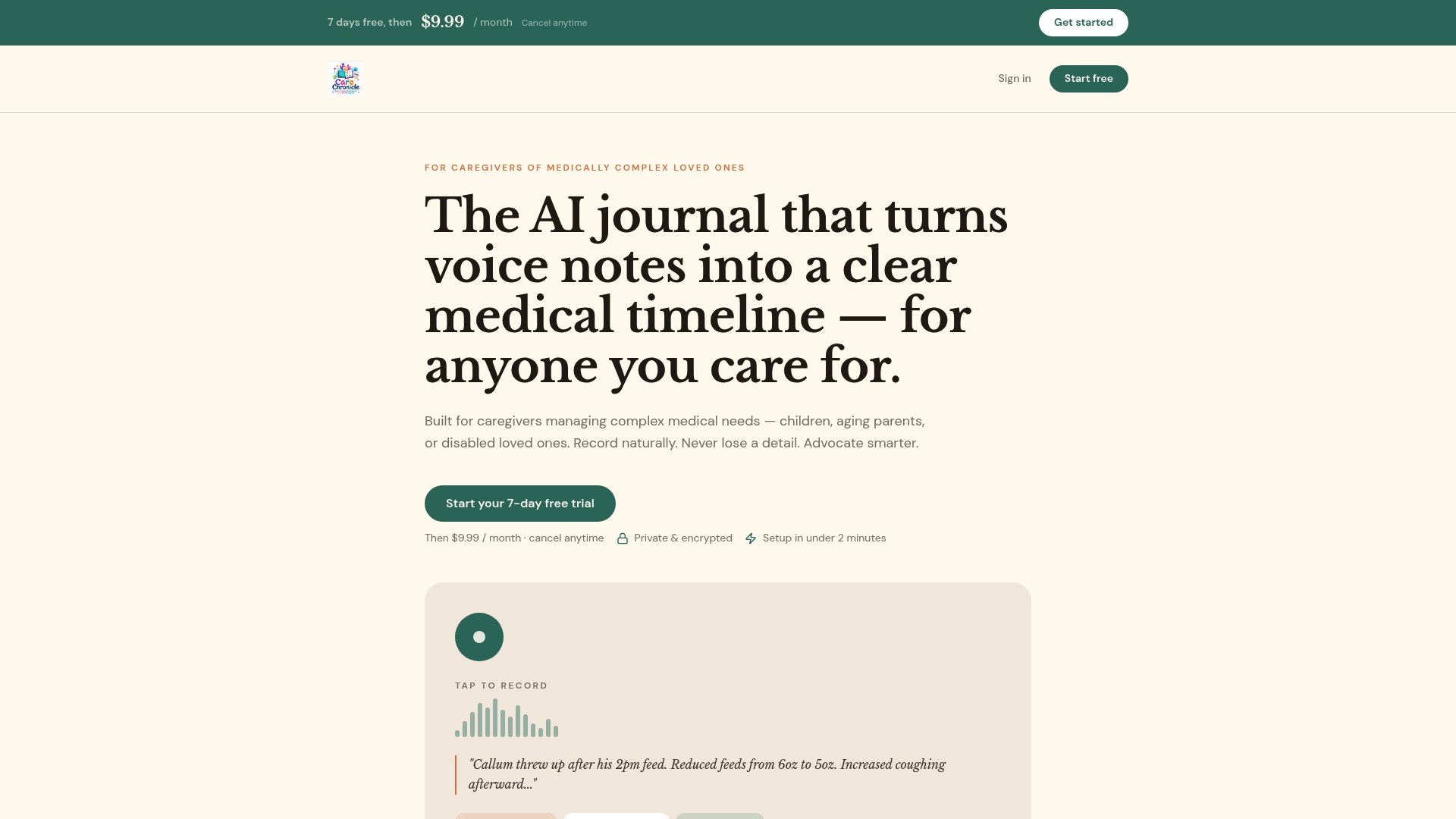
Mycarechronicle's Care Chronicle lets you capture care updates by voice in real time, then organizes everything into a clean, searchable medical timeline you can share with a clinician or a family member in seconds. No binders, no lost notes, no 45-minute phone briefings when a sibling takes over for the weekend. The app supports medication tracking, symptom patterns, and exportable reports, so the cognitive work of care coordination doesn't have to live entirely in your head.
It won't replace your therapist, your support group, or your primary care provider. What it does is reduce the documentation friction that quietly drains energy every single day. For caregivers managing complex medical situations, that reduction in cognitive load is real and immediate.
Start with a 7-day free trial and see how much lighter the next doctor's visit feels.
Useful sources and next-step resources
These are the authoritative sources behind this guide, plus practical places to find local help in the United States.
For deeper reading:
- Cleveland Clinic — Caregiver Burnout: What It Is, Symptoms & Prevention: Comprehensive clinical overview including symptoms, causes, and treatment options.
- Mayo Clinic — Caregiver stress: Tips for taking care of yourself: Evidence-based prevention strategies and self-care guidance.
- CDC — Healthy Habits: Caring for Yourself When Caring for Another: Public health guidance on respite and caregiver wellness.
- National Institute on Aging — Taking care of yourself: Tips for caregivers: Sleep, exercise, and routine recommendations from a federal health authority.
- Harvard Health — Relief for caregiver burnout: Practical strategies including delegation, support groups, and self-compassion.
For local respite and support:
- Eldercare Locator: eldercare.acl.gov — enter your ZIP code to find your local Area Agency on Aging
- ARCH National Respite Network: archrespite.org — state-by-state respite program locator
- AARP Caregiver Resource Center: aarp.org/caregiving — guides, legal tools, and local referrals
- 988 Suicide and Crisis Lifeline: call or text 988 if you or someone you care for is in crisis
How to use these resources:
When you contact a local agency, bring or have ready: a brief description of your caregiving situation, the care recipient's diagnosis and current medications, your own insurance information, and a note about your work schedule. The more specific you are, the faster they can match you to the right program. If sleep disruption is a major issue, a conversation with your primary care provider about sleep and physical recovery may also be worth having alongside any mental health support.
This article is general health information, not professional medical or mental health advice. Confirm your specific situation with a qualified provider or your primary care physician.