
Care Chronicle is the best medication tracker app for family caregivers managing complex medical needs. It captures health events by voice, organizes them into a searchable chronological timeline, and exports clinician-ready PDFs that you can share with any provider in seconds. A free trial period gets you started; after that, it runs on a monthly subscription.
Table of Contents
- What features should a medication tracker app have?
- How does Care Chronicle meet these caregiver needs?
- How do you set up Care Chronicle for daily use?
- What should U.S. caregivers check about privacy and HIPAA?
- What does Care Chronicle cost, and what should you test during the trial?
- When does Care Chronicle need a different or additional tool?
- Key Takeaways
- Why the "best app" question misses the real problem
- Care Chronicle's 7-day free trial
- Useful sources
What features should a medication tracker app have?
Not every pill reminder app is built for caregivers juggling multiple medications, multiple providers, and multiple family members trying to help. The gap between a basic alarm app and a genuinely useful medication schedule tracker is wide. Here is what actually matters.
Core tracking capabilities:
- Medication reminders with flexible scheduling (time-of-day, with-food, as-needed)
- Drug-interaction checking and refill alerts before you run out
- Vitals and symptom logging tied to specific doses, so you can track symptoms over time alongside adherence
- Clinician-ready export: a chronological PDF or secure shareable link
Ease of capturing data:
- Voice-to-text logging so you can record an event hands-free during a hospital discharge or a flare-up
- Barcode or scan import to reduce manual entry for complex multi-medication regimens
- One-touch dose logging for daily use
Sharing and care-team features:
- Multi-caregiver access so a spouse, sibling, or home aide can all contribute
- Missed-dose notifications sent to family members, not just the primary caregiver
- Secure report sharing with providers via PDF or link
Platform and accessibility:
- iOS, Android, and web access
- Large-button UI and readable font sizes for elderly users or anyone with low vision
Privacy and security:
- HIPAA-compliant data handling
- Business Associate Agreement (BAA) availability for U.S. caregivers
- Encryption in transit and at rest, plus data export and backup controls
Pro Tip: Prioritize apps that reduce manual entry first. Voice capture and barcode import are the two features that determine whether you actually use an app six months from now.
How does Care Chronicle meet these caregiver needs?
In 2026, medication tracking is shifting away from standalone alarm apps toward integrated, AI-assisted timelines that combine medications, symptoms, and exportable reports. Care Chronicle is built around exactly that model.
| Feature category | What caregivers need | Care Chronicle |
|---|---|---|
| Capture method | Voice-to-text, low manual input | AI transcribes voice notes into timeline entries |
| Medication logging | Dose history, refill alerts | Logs medications with timestamps, searchable |
| Vitals and symptoms | Tied to dose events, pattern-visible | Symptom and vitals notes on the same timeline |
| Multi-caregiver access | Family members can contribute | Multiple contributors per profile |
| Export and sharing | Clinician-ready PDF, secure link | Exportable PDF and secure shareable timeline link |
| Platform | iOS, Android, web | Available across devices |
| Privacy | HIPAA, BAA, encrypted | Secure data handling with export controls |
The voice-first design is the practical differentiator. After a hospital discharge or a rough night, typing a detailed note is the last thing you want to do. Speaking it takes ten seconds. Care Chronicle transcribes that note and places it in the right spot on the timeline automatically.
Exportable, clinician-ready chronological PDFs that combine medication events with vitals and symptom notes are the single most time-saving artifact caregivers can generate for appointments. Care Chronicle produces exactly that format.
Pro Tip: After your first week, run a test export and share it with one family member. If they can read the timeline without asking you questions, the format is working.
How do you set up Care Chronicle for daily use?
Setup takes under 20 minutes if you follow this order.
- Create a profile for your loved one (name, date of birth, primary conditions).
- Add medications by scanning barcodes or speaking them aloud via voice capture.
- Invite at least one other caregiver so missed-dose alerts go to more than one person.
- Set medication reminders and refill alerts for each drug.
- Enable export options so your first clinician-ready PDF is one tap away.
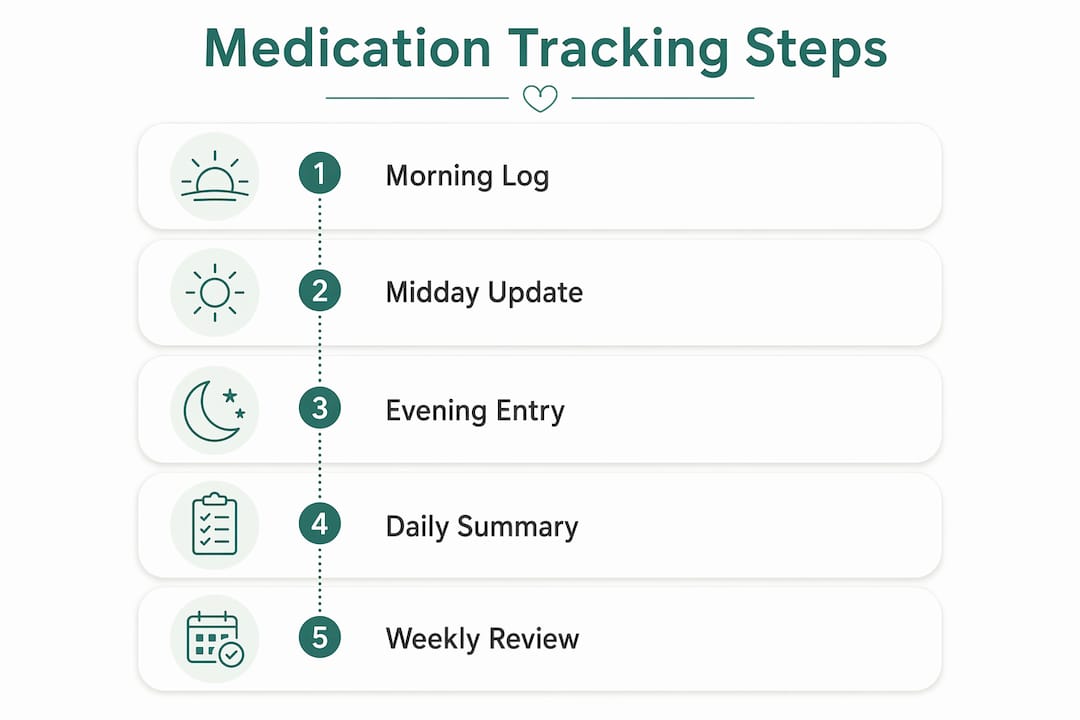
Once that foundation is in place, the daily workflow is light. A sample routine:
Morning: Confirm the overnight notes are captured. Log morning medications with one tap or a quick voice note. Record any overnight symptoms.
Midday: Log midday doses. If anything unusual happened (a fall, a mood shift, a new symptom), speak a voice note immediately. Detail fades fast.
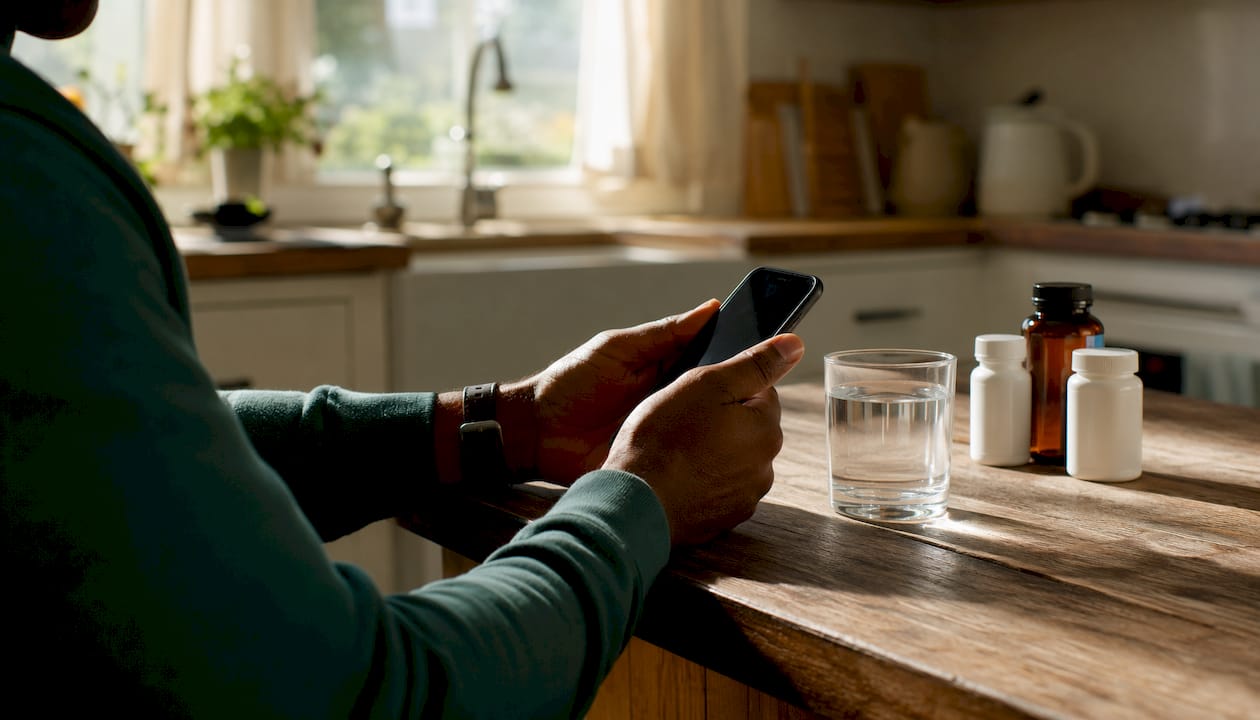
Evening: Log evening medications. Before bed, do a 60-second voice summary of the day. That summary becomes a timeline entry you can search later.
For family caregivers managing chronic illness, the biggest risk is data drift: gaps in the record that make it impossible to see patterns. Voice notes close those gaps without adding friction.
Pro Tip: During a hospital discharge, open Care Chronicle before you leave the building and speak the discharge instructions aloud. You will capture medication changes, follow-up dates, and provider names in one pass.
What should U.S. caregivers check about privacy and HIPAA?
Health data is sensitive. Before you store or share a loved one's medication history in any app, run through this checklist.
- HIPAA compliance: Does the vendor explicitly state HIPAA-compliant data handling?
- BAA availability: Can you request a Business Associate Agreement? For U.S. caregivers sharing data with covered entities (hospitals, clinics), a BAA is the document that makes that sharing legally appropriate.
- Encryption: Is data encrypted both in transit (when it moves) and at rest (when it is stored)?
- Export and deletion controls: Can you export your full data and delete your account on request?
- Secure sharing: Are shared report links password-protected or time-limited?
Many health apps have historically had security vulnerabilities, so verifying these points before you share records with a clinician is worth the five minutes it takes. Read the privacy policy, look for a BAA option in the settings or support documentation, and confirm the sharing method before you send anything.
On the device level: use a passcode or biometric lock on any phone or tablet that has access to the app. That single step prevents most unauthorized access.
What does Care Chronicle cost, and what should you test during the trial?
Care Chronicle offers a 7-day free trial before the monthly subscription begins. That week is enough time to evaluate whether the app fits your workflow.
During the trial, test these specifically:
- Voice transcription accuracy: Speak a complex medication name and a symptom description. Check whether the transcript is accurate enough to be useful.
- Export workflow: Generate a PDF and review it as if you were handing it to a clinician. Is the timeline clear?
- Caregiver invite flow: Add one family member and confirm they can see the timeline and receive notifications.
- Refill and reminder reliability: Set a reminder and a refill alert and confirm both fire correctly.
The value of a medication tracking app is not just fewer missed doses. It is the reduction in cognitive load: fewer calls to the pharmacy, fewer scrambled notes before appointments, and fewer moments where you cannot remember when a symptom started.
When does Care Chronicle need a different or additional tool?
Care Chronicle handles the caregiver-side record. Some situations call for additional tools or clinical systems alongside it.
- Direct EHR integration required: If a clinician needs data fed directly into Epic, Cerner, or another electronic health record system, a dedicated integration layer or a facility-managed app is necessary. Use Care Chronicle's exported PDF to bridge the gap manually until a direct integration is available.
- Locked or automated dispensers: For patients who cannot self-administer safely, a hardware dispenser (such as a locked automated pill dispenser) handles physical medication security. Care Chronicle logs what was dispensed; it does not control the dispenser.
- Infusion or IV medication management: Infusion pumps and IV protocols require clinical-grade systems. These are facility-managed and outside the scope of any consumer app.
- Pharmacy refill automation: If your pharmacy offers auto-refill or a medication synchronization program, enroll in that separately. Use Care Chronicle's refill alerts as a backup layer, not a replacement.
For complex medication management that involves behavioral health or clinical coordination, a treatment center's medication management program may run alongside a caregiver app rather than replace it.
Key Takeaways
Care Chronicle is the strongest medication tracker app for family caregivers because voice-first capture and clinician-ready PDF export solve the two problems that sink other apps: data gaps and appointment prep.
| Point | Details |
|---|---|
| Voice capture closes data gaps | Speaking a note after a hospital discharge takes ten seconds and lands on the timeline automatically. |
| Clinician-ready PDFs save appointment time | A combined medication, vitals, and symptom timeline gives providers context without a verbal recap. |
| Multi-caregiver access lowers cognitive load | Inviting one family member means missed-dose alerts reach more than one person. |
| Trial checklist matters | Test voice accuracy, export quality, and caregiver invite flow within the 7-day free trial. |
| Care Chronicle fits this need | It combines voice-first logging, symptom tracking, and secure export in one app built for caregivers. |
Why the "best app" question misses the real problem
Most caregiver app comparisons focus on feature lists. The real question is: which app will you actually use at 11 PM after a hard day? That is a different question, and the answer is almost always the one that requires the least typing.
The conventional wisdom says to find an app with the most features. In practice, feature overload is what kills long-term use. Caregivers managing complex regimens do not need fifty options. They need voice capture that works, a timeline they can hand to a doctor, and a way to loop in family members without a tutorial. Everything else is noise.
What gets overlooked in most roundups is the export format. A PDF that reads like a medical narrative, not a data dump, is what actually saves time at a specialist appointment. That is the detail worth evaluating during any free trial.
Care Chronicle's 7-day free trial
Caregivers managing complex medical needs deserve a tool that works as hard as they do. Care Chronicle gives you a full week to test voice capture, generate your first clinician-ready export, and invite a family member to contribute, all before any charge.
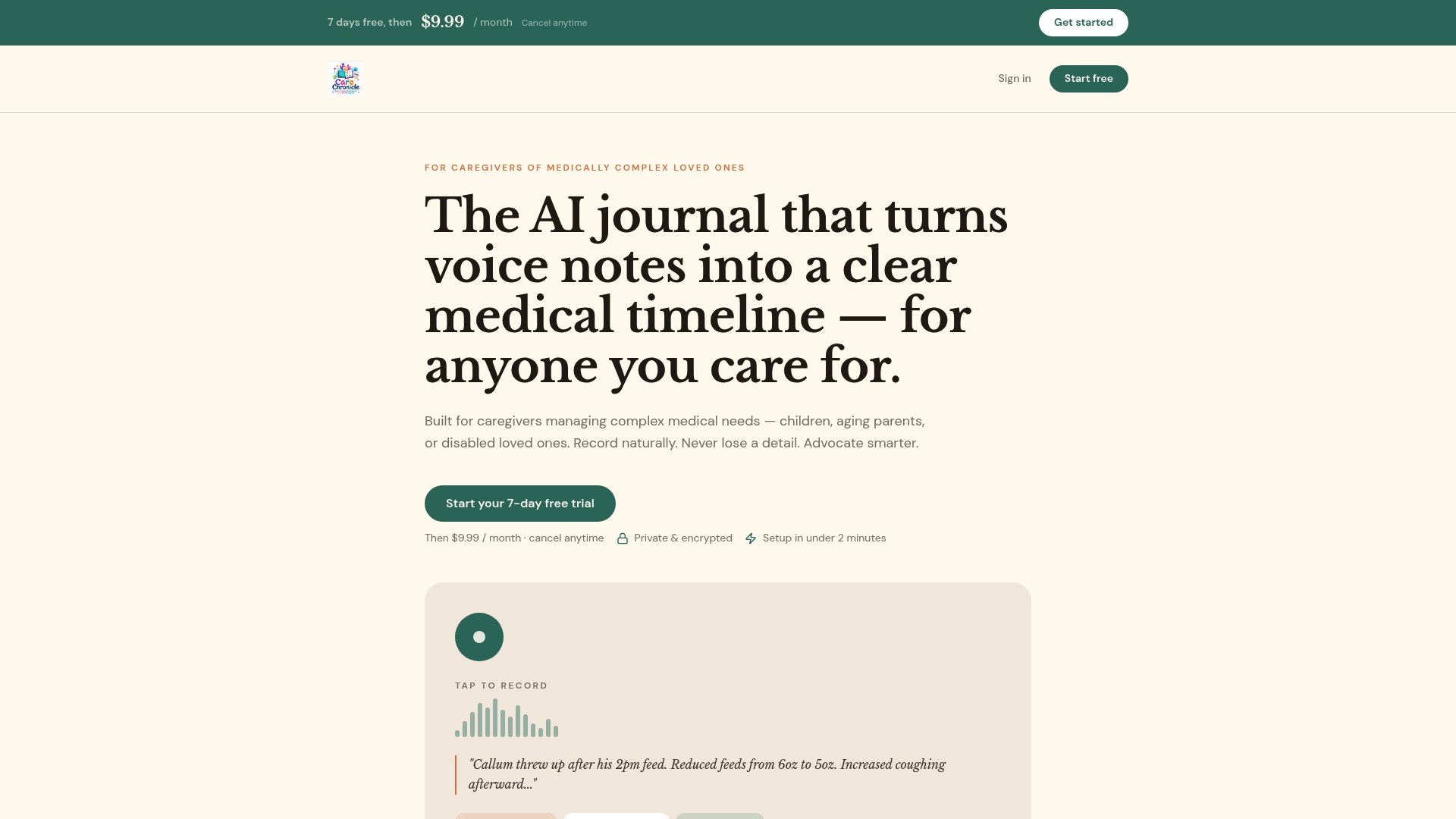
Start your free trial today. No complicated setup, no long-term commitment required. If the timeline and export features do not fit your workflow within seven days, you walk away with nothing owed. For caregivers who want to go further, the app includes guides on medication tracking, hospital discharge documentation, and symptom pattern recognition.
Useful sources
- Top Medication Reminder Apps to Try in 2026 — industry overview of AI-assisted tracking trends and security considerations
- MyTherapy medication reminder and pill tracker — feature reference for vitals logging and symptom tracking alongside medications
- Medisafe Pill Reminder (App Store) — reference for clinician-ready export and secure sharing formats
- Medisafe on Google Play — multi-caregiver connectivity and missed-dose notification features
- SingleCare: Best Medication Reminder Apps — roundup covering refill reminders and progress sharing
- Pill Remap barcode import features — reference for barcode scanning and import to reduce manual entry
- Care Chronicle — product page for voice-first caregiver journal, timeline export, and trial details