
A dementia behavior log is a short, objective record of what happened just before a behavior (the antecedent), the behavior itself, and what followed (the consequence). That three-part structure, the ABC model, is the same framework clinicians use to evaluate behavioral and psychological symptoms of dementia (BPSD). Start one today: the next time an episode occurs, spend 30 seconds writing down the time, what triggered it, what you saw, what you tried, and whether it helped. That single entry is more useful than a week of mental notes.
Pro Tip: Don't wait for a "good" moment to start logging. A 30-second entry made immediately after an episode preserves details that fade within hours. Mycarechronicle's voice-first capture lets you speak that entry in real time, hands-free.
Table of Contents
- What is a behavior log and why does it help you?
- Which behaviors and context should you record?
- How to write each entry using the ABC template
- How often should you record, and how long before patterns emerge?
- How do you turn raw logs into a useful clinician summary?
- What format works best for tracking dementia behavior?
- Practical tips for consistent, objective logging
- Key Takeaways
- Why the "just observe" advice misses the point
- Mycarechronicle makes the ABC workflow faster
- Useful sources for caregivers and clinicians
What is a behavior log and why does it help you?
A behavior log (sometimes called a behavior chart or dementia behavior journal) is a factual, time-stamped record of behavioral episodes and the context surrounding them. It is not a diary of frustrations. Think of it as a clinical communication tool: objective notes that let you and a clinician look at the same data and ask the same questions together.
The ABC framework structures each entry around three elements: the antecedent (what happened right before), the behavior (what you observed), and the consequence (what you did and what happened next). That structure shifts the caregiver's mindset from "why is this happening to me?" to "what changed, and what can I test?"

Scattered observations stay scattered. A log converts them into patterns. Repeated agitation at 4:30 PM every day points to sundowning. Sudden confusion after a new prescription points to a medication side effect. Reversible causes like urinary tract infections, dehydration, pain, and medication changes frequently drive behavioral changes that look, on the surface, like dementia progression.
The primary goals of keeping a dementia behavior log:
- Detect medical causes behind sudden behavioral shifts (infections, pain, medication side effects)
- Identify environmental and routine triggers (noise, transitions, missed meals, poor sleep)
- Test whether an intervention actually works by comparing before and after
- Build a factual baseline clinicians can use to adjust care plans and medications
- Improve safety by anticipating high-risk times and situations
Which behaviors and context should you record?
Not every behavior needs a full entry, but certain categories carry the most clinical weight. Prioritize these first:
- Agitation and aggression: verbal outbursts, hitting, resisting care
- Wandering: leaving a safe area, pacing, attempting to exit
- Sundowning: late-afternoon or evening confusion and restlessness
- Repetitive behaviors: asking the same question, repeating an action
- Refusal: refusing medications, meals, bathing, or dressing
- Withdrawal: sudden disinterest in food, conversation, or usual activities
- Hallucinations or delusions: describing things that aren't there, paranoid statements
- Sleep changes: nighttime waking, sleeping far more or less than usual
- Appetite changes: refusing meals, eating significantly less
The NIA notes that environmental factors, including noise, lighting, transitions between activities, and missed meals, commonly trigger or worsen these symptoms. So context matters as much as the behavior itself. Every entry should capture:
- Date and time
- Location (bedroom, kitchen, during a care task)
- Who was present
- What activity was happening
- Any recent medication changes or doses given
- Sleep quality the night before
- Appetite at the last meal
- Any visible signs of pain or discomfort
- Sensory environment (loud TV, unfamiliar visitors, bright lights)
Small shifts matter too. A gradual drop in appetite or quiet daytime withdrawal often precedes a larger clinical problem like an infection or medication effect. Don't log only the dramatic episodes.
For early-stage dementia, a shorter daily log focusing on mood and sleep may be enough. For moderate to late stages, episode-by-episode capture becomes more valuable because behavioral changes are more frequent and more clinically significant.

How to write each entry using the ABC template
The ABC model works because it forces specificity. "He got upset at dinner" tells a clinician almost nothing. "He pushed the plate away and shouted 'get away from me' when the TV was on loudly during a meal change" tells them quite a lot.
Why ABC shifts the mindset: When you document the antecedent, you stop asking "what's wrong with him?" and start asking "what was different this time?" That reframe is what makes the ABC approach a practical intervention tool, not just a record-keeping exercise. Change one variable at a time, then track whether the behavior frequency or severity shifts over the next baseline window.
Full ABC entry template
| Field | Example: Agitation episode | Example: Wandering |
|---|---|---|
| Date/Time | Tuesday, 5 PM | Wednesday, 2 AM |
| Antecedent (trigger) | TV on loud; caregiver asked her to take medication | Woke from sleep; bedroom door left open |
| Behavior (observable) | Pushed caregiver's hand away, shouted "leave me alone," stood up abruptly | Found in kitchen, disoriented, said "I need to go home" |
| Caregiver response | Turned off TV, spoke calmly, offered water first | Gently guided back to bedroom, used familiar music |
| Outcome | Calmed within 5 minutes of TV off | Returned to sleep |
| Medications | Donepezil given in the morning; no changes | No changes |
| Sleep/Appetite | Slept 5 hours previous night; ate half of lunch | Napped 2 hours during day |
| Logged by | M. Rivera (daughter) | M. Rivera |
| Privacy note | Stored in secure app; not shared externally | Same. |
Quick 5-field entry (30 seconds)
When you only have half a minute, capture these five fields and fill in the rest later:
- Time and date
- What happened just before (one sentence)
- What the behavior looked like (one sentence, observable facts only)
- What you tried
- Did it help? (yes / no / partly)
That minimum entry is far more useful than a perfect retrospective written hours later. Real-time nuance, the tone of voice, the specific trigger, the exact sequence, disappears fast.
How often should you record, and how long before patterns emerge?
Record every episode if you can. For behaviors that happen multiple times a day, aim for at least one entry per shift or per day that captures the most significant episode and any notable changes in baseline mood, sleep, or appetite.
For baseline collection, clinical guidance recommends establishing a clear baseline before drawing conclusions or starting new interventions, because many medication trials and behavioral interventions require several weeks to show measurable effect. A practical framework:
- 7–14 days: enough to spot short-term patterns like sundowning windows or mealtime triggers
- 30 days: the minimum window for evaluating whether a new routine or environmental change is working
- 60–90 days: needed for medication comparisons, where you want a stable before period and a stable after period
A meaningful pattern repeats at similar times, links to the same antecedent across multiple entries, or shows a clear change in frequency or severity after an intervention. One episode is an observation. Three episodes with the same trigger at the same time of day is a pattern worth bringing to a clinician.
Establishing a baseline during stable periods is especially valuable because dementia progression is non-linear. When you have a documented stable baseline, a sudden spike in agitation or confusion stands out immediately as a deviation worth investigating, rather than blending into the background noise of day-to-day variation.
Pro Tip: Log both big incidents and quiet changes. A week of reduced appetite or increased daytime sleeping often signals an infection or medication issue before any dramatic episode occurs. Those early entries are the ones that help clinicians catch problems fast.
How do you turn raw logs into a useful clinician summary?
Handing a clinician a stack of raw diary entries wastes their time and buries the signal. What clinicians actually want is a one-page summary that answers four questions: What is the main behavior concern? When did it start? How often is it happening? What has been tried?
Start your summary with a short paragraph: the chief behavioral concern, when it first appeared or worsened, a rough frequency (episodes per day or per week), the most common timing, and your top two or three suspected triggers. That paragraph alone saves significant appointment time.
The most clinically useful data to include:
- Episode counts over 7, 30, and 90-day windows
- Time-of-day patterns (e.g., "80% of agitation episodes occur between 4 PM and 7 PM")
- Top three triggers identified across entries
- Which interventions were tried and whether they helped, partially helped, or had no effect
- Any medication starts, stops, or dose changes during the tracking period
- Notable health events (illness, hospitalization, sleep disruption)
A simple one-page visit report might look like this: a header with the person's name, date range, and primary caregiver; a three-sentence baseline summary; a short table of episode counts by week; a trigger frequency list; and a medication change timeline. That format lets a geriatrician or neurologist scan it in under two minutes and ask targeted follow-up questions.
Pro Tip: Summarize patterns, don't transcribe entries. Clinicians use frequency, timing, trigger, and intervention effectiveness to triage next steps. A clean summary signals that you're a reliable observer, which directly affects how seriously your concerns are taken.
Sudden, large behavioral changes deserve special attention in any summary. Acute delirium from infection, dehydration, or medication toxicity can look identical to dementia worsening. A log that shows a clear before/after baseline gives clinicians the evidence they need to order an urgent workup rather than attributing the change to disease progression.
What format works best for tracking dementia behavior?
The best format is the one you'll actually use consistently. Here's how the main options compare:
| Format | Speed of capture | Searchability | Shareable with clinician | Privacy control |
|---|---|---|---|---|
| Paper notebook | Fast (pen always ready) | None (manual scan) | Photocopy or bring in person | High (offline) |
| Spreadsheet | Moderate (typing required) | Good (filter/sort) | Email or print | Moderate (cloud sync risk) |
| Voice-first app | Fastest (speak, don't type) | Excellent (AI transcription) | Export PDF or secure link | High (app-controlled) |
Paper notebook works well for caregivers who are rarely near a device during episodes, or who prefer a tactile habit. Keep it in one fixed location, use a consistent column format, and photograph pages before appointments.
Spreadsheets (Google Sheets, Excel) give you filtering and sorting, which helps when you're building a clinician summary. The tradeoff is that typing a full entry mid-episode is slow, and most caregivers end up reconstructing entries from memory later.
Voice-first apps solve the speed problem. Speaking a 30-second entry immediately after an episode captures details that typing would lose. Mycarechronicle is built for exactly this workflow: you speak your observation, it transcribes and organizes the entry into a chronological timeline, and you can export a clinician-ready PDF when the appointment comes. Multiple caregivers can contribute entries, which matters in shared-care situations where a night caregiver and a day caregiver are both logging.
For caregivers who want practical behavior management strategies alongside their logging routine, the behavior management resources at SNAP Brain Health offer straightforward, everyday approaches that complement a structured log.
Two quick templates you can use immediately:
- Daily incident sheet (1 page): Five columns across the top (Time, Antecedent, Behavior, Response, Outcome) with rows for up to six entries per day. Add a notes box at the bottom for sleep, appetite, and medication changes.
- 30-second quick card (pocket or phone note): Five fields only: Time / Before / Behavior / Tried / Helped? Print it on a 3x5 card or save it as a phone note template.
Practical tips for consistent, objective logging
The biggest threat to a useful behavior log isn't forgetting to log. It's logging in a way that drifts from facts into interpretation. "She was being difficult" is an interpretation. "She refused to take her medication three times, crossed her arms, and turned away" is a fact. Clinicians can work with the second one.
- Write what you saw and heard, not what you think it meant. Verbs and direct quotes are your best tools.
- Keep the log in one fixed place (physical or digital) so every caregiver uses the same record.
- Build a 2-minute end-of-shift habit: review the day, add any missed entries, note sleep and appetite.
- Rotate logging duties when multiple caregivers are involved. No single person should carry the full documentation burden.
- Note your own stress level as a brief field. Caregiver state affects how episodes unfold and how responses are perceived, and it's useful context for a clinician reviewing a difficult stretch.
- If an entry feels too long to write, use the 5-field quick card. Completeness is a nice-to-have; consistency is the requirement.
For additional context on how environmental and physical factors connect to behavior, the brain health blog at SNAP Brain Health covers practical contributors worth understanding alongside your log.
Pro Tip: Consistency beats completeness. A 30-second immediate entry is far more useful than a detailed reconstruction written two hours later. Start small, stay consistent, and add detail as the habit builds.
Key Takeaways
A behavior log built on the ABC method gives clinicians the frequency, timing, trigger, and intervention data they need to adjust care plans, and it gives caregivers a way to spot medical causes before they escalate.
| Point | Details |
|---|---|
| Start with the ABC format | Record antecedent, behavior, and consequence for every episode, even in just 30 seconds. |
| Collect a baseline of 7–30 days | Short-term patterns need at least 7–14 days; medication comparisons need 30–90 days. |
| Summarize before the appointment | Give clinicians episode counts, timing patterns, top triggers, and intervention outcomes, not raw entries. |
| Log quiet changes too | Drops in appetite or increased withdrawal often signal infections or medication effects before dramatic episodes appear. |
| Use Mycarechronicle for voice-first capture | Speak entries in real time, export a clinician-ready PDF, and share securely across multiple caregivers. |
Why the "just observe" advice misses the point
Most caregivers are told to "keep an eye on things" and "write down what you notice." That advice is well-meaning and almost useless. Observation without structure produces a pile of impressions that no clinician can act on and that no caregiver can search through at 11 PM when they're trying to remember what worked last Tuesday.
The ABC model matters not because it's a clinical formality, but because it forces you to separate what happened from what you felt about it. That separation is genuinely hard when you're exhausted and emotionally involved. But it's also where the useful information lives. A log entry that says "he was aggressive again" tells you nothing about whether the aggression happened before or after a medication dose, whether the TV was on, whether he'd slept poorly, or whether the caregiver who was present was someone unfamiliar to him. All of those details are potential levers.
The other thing most guides understate: a behavior log protects the caregiver, not just the person with dementia. When you bring a documented pattern to a clinician and they see that agitation spikes every day at 5 PM regardless of who's present, it removes the implicit question of whether the caregiver is doing something wrong. Objective data is advocacy. It shifts the conversation from "how are you coping?" to "what do we change?"
Start imperfect. A notebook with five fields and inconsistent handwriting is a better clinical tool than a blank page waiting for the perfect system.
Mycarechronicle makes the ABC workflow faster
Logging dementia behaviors consistently is hard enough without fighting your tools. Mycarechronicle is built for caregivers who need to capture an episode in real time, not reconstruct it from memory an hour later.
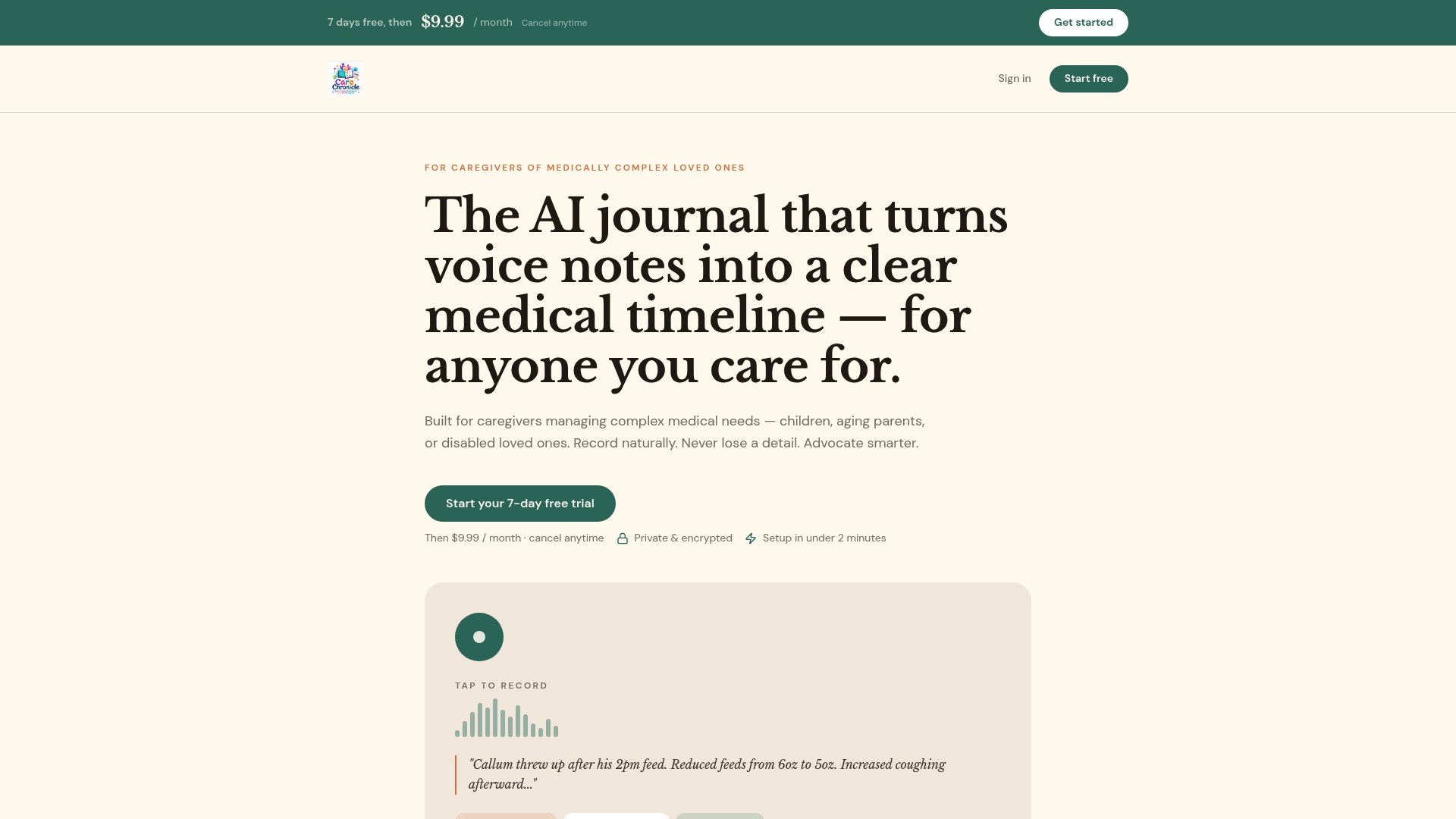
Speak a 30-second entry immediately after an episode and Mycarechronicle transcribes it, timestamps it, and places it in a chronological timeline alongside medications, symptoms, and care notes. Multiple caregivers can contribute to the same record, so night and day shifts stay connected. When an appointment comes, export a clean PDF summary with episode counts, timing patterns, and medication changes already organized. No reformatting, no retyping.
The 7-day free trial gives you enough time to build a real baseline and see what the pattern view looks like before you commit. Start your trial at Mycarechronicle and bring something concrete to your next clinician visit.
Useful sources for caregivers and clinicians
These U.S.-focused references provide deeper clinical context and validated guidance for dementia behavior tracking:
- NIA: Managing Personality and Behavior Changes in Alzheimer's — Caregiver-friendly overview of common behavioral changes, environmental contributors, and practical coping strategies. Start here if you're new to dementia caregiving.
- StatPearls / NCBI: Behavioral and Psychological Symptoms in Dementia — Clinician-focused reference covering BPSD assessment, baseline measurement, validated instruments (NPI, BEHAVE-AD), and medication trial guidance. Useful for caregivers preparing for specialist appointments.
- Psychology Today: Use Antecedents and Consequences to Manage Dementia Behaviors — Accessible, step-by-step explanation of the ABC model for caregivers. Good companion to the templates in this article.
- HelpDementia: What to Include in a Dementia Behavior Log — Practical, caregiver-written guidance on exact fields to record, with examples. Useful for building your first daily incident sheet.
Bring your summarized log, not raw entries, to every doctor, geriatrician, or neurologist visit. If you're using Mycarechronicle, the PDF export function generates a clinician-ready summary directly from your entries, formatted for a desk handoff.
This article provides general information for caregivers and is not a substitute for professional medical advice. Confirm current clinical guidelines and care decisions with a qualified healthcare provider.